Roof Failure Identified During Leak Investigation in Urbandale
“We had a customer with a roof issue that nobody could diagnose. Other roofers and inspectors had looked at it, and nothing ever really lined up. Once StructSolve got involved, the problem finally made sense.”
- Nick O’Hara, Mighty Dogs Roofing
Roof Failure Identified During Leak Investigation in Urbandale
A residential property in Urbandale, Iowa was initially evaluated for what appeared to be a recurring chimney leak. The homeowner had experienced ongoing water intrusion, and prior inspections had focused primarily on roofing materials and flashing conditions. Despite multiple attempts to address the issue, the leak persisted and signs of broader distress began to emerge.

Mighty Dogs Roofing was contacted to perform a more thorough evaluation. According to contractor observations, the symptoms suggested that the issue extended beyond typical roofing failures. Rather than isolated water entry, the condition appeared tied to movement and deformation within the roof structure itself. At that point, the investigation shifted from surface materials to the framing system supporting the roof.
Field Observations Point to Structural Damage

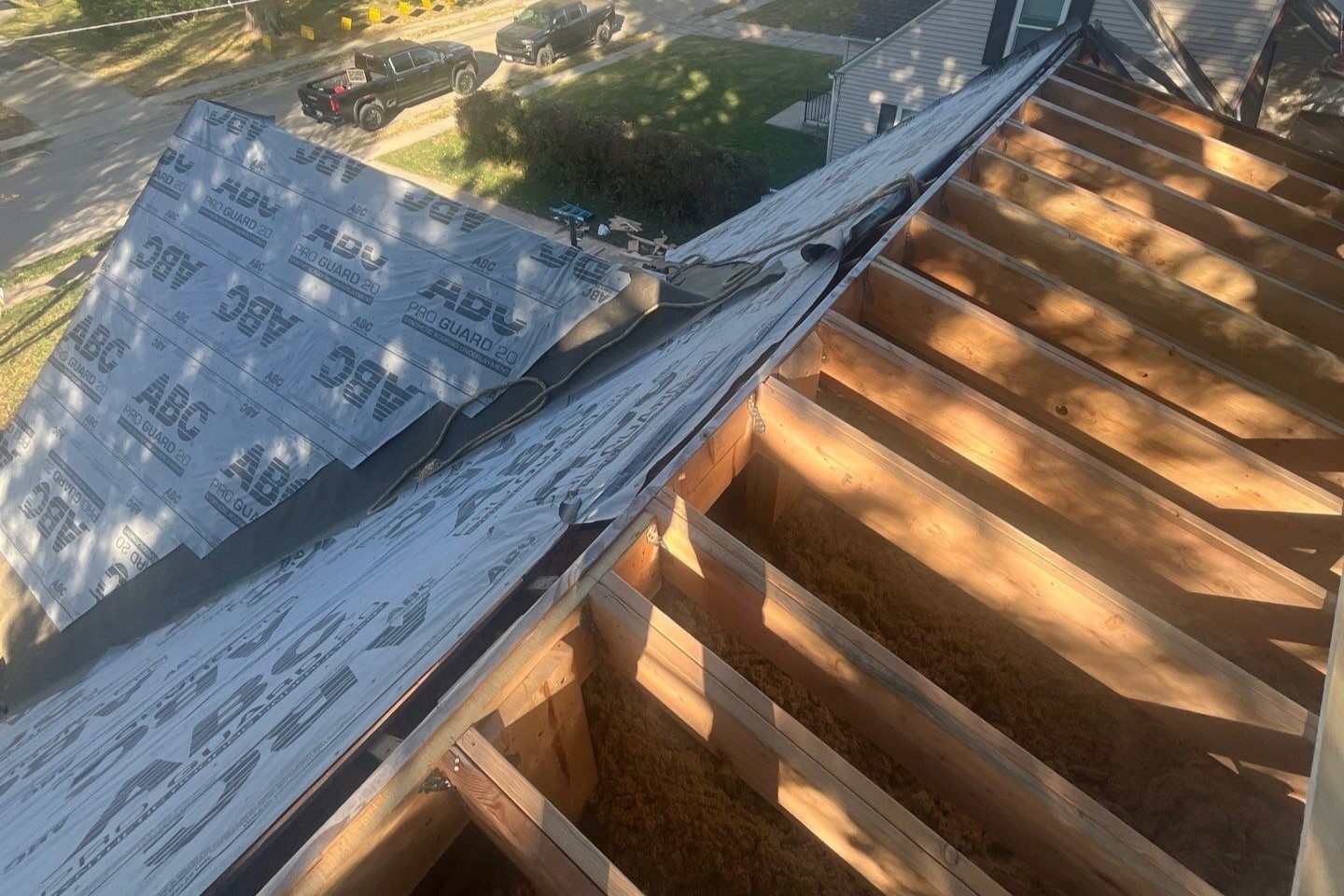
Interior access to the attic revealed widespread distress across the rafter system. Multiple rafters were found to be fractured or separated near the ridge line. The damage pattern was consistent across the affected roof plane and was not limited to a single localized failure. Visual sagging was also evident from the exterior, indicating loss of structural continuity.
Roof geometry played a significant role in the observed damage. One side of the roof had a slope below 3:12, while the opposite side transitioned to a much steeper pitch. During winter conditions, snow accumulated on the lower-slope side, creating unbalanced loading. Over time, this load exceeded the capacity of the framing members.
The home was originally constructed in 1941, and the roof framing reflected construction practices typical of that era. Member sizing and connection methods no longer align with current structural standards. These factors contributed to the system’s inability to resist modern snow load demands.
Permit Review Requires Engineering Evaluation
Due to the extent of visible damage and the low roof slope, the Urbandale permit office required a structural engineering review before any corrective work could proceed. Replacement of damaged members without engineering justification was not permitted under current code requirements.

StructSolve Engineering was engaged to evaluate the framing system and determine an appropriate repair approach. The engineering review focused on member spans, connection behavior, and load paths within the roof assembly.
The evaluation identified two primary deficiencies. Existing rafters exceeded allowable span limits for the applied snow and dead loads. In addition, ridge connections relied on toenailing, which did not provide sufficient capacity to transfer forces under sustained loading conditions. These findings confirmed that a structural solution was necessary to address the root cause of failure.
Engineering Design and On-Site Collaboration
The engineered repair solution called for replacing the existing rafters with 2x10 members and upgrading connections using manufactured rafter hangers and ridge straps. Fastener schedules and installation requirements were specified to ensure load transfer met current code expectations.

Engineering involvement extended beyond design documentation. StructSolve personnel were present on site at multiple stages of construction to verify material selection, framing layout, and installation methods. This level of oversight was particularly important given the age of the structure and the presence of irregular field conditions.

Material availability also required coordination. Certain specified lumber grades were difficult to source, and the engineering team adjusted the design to accommodate readily available materials while maintaining structural performance. This flexibility allowed construction to proceed without compromising safety or compliance.
Documentation Supports Insurance Approval
The final engineering documentation included load analysis, framing diagrams, and detailed connection requirements. The report confirmed that the original framing was undersized and that the proposed repairs addressed both the symptoms and the underlying structural deficiencies.
With stamped engineering documents and verified construction oversight, the insurance carrier approved full coverage for the repair. Prior to engineering involvement, insurance had indicated that only partial coverage would be provided. The presence of a documented structural solution and professional oversight gave the insurer confidence in the scope and outcome of the work.
Contractor Perspective

Nick O’Hara emphasized the importance of engineering involvement throughout the project. He noted that having engineers on site helped align the contractor, homeowner, and insurer around a shared understanding of the problem and the solution.
“Once StructSolve was involved, everything became clearer. Having engineers on site gave everyone confidence in the outcome. Insurance approved the full repair, and the homeowner finally felt comfortable with the solution.”
- Nick O’Hara, Mighty Dogs Roofing
He also noted that StructSolve has since become his first call when structural questions arise and that he continues to refer similar cases when engineering input is needed.
StructSolve Perspective
Caleb Vorpahl reflected on the broader importance of projects like this one.
“Strong contractor relationships are essential for bringing accountability back into residential construction. When engineers and contractors work together in the field, the outcome is clearer, safer, and more defensible. We are proud to work with contractors who take that responsibility seriously.”
- Caleb Vorpahl, President and Founder
Project Details
Location: Urbandale, Iowa
Contractor: Nick O'Hara, Mighty Dog Roofing
Service: Project-Specific Design
Scope: Roof rafter failure due to snow load and undersized framing